
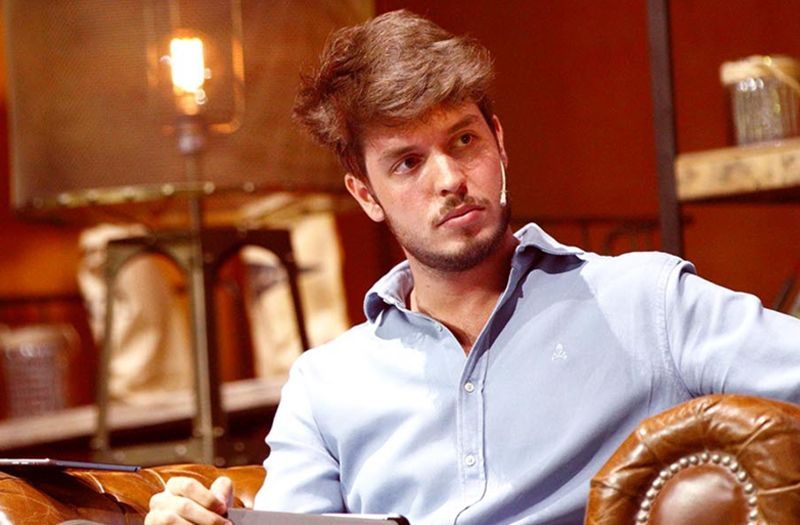
I’ve said it 1,000 times, but I will say it once more: I decided to become an entrepreneur after attending a talk of Pablo for the first time. For the record, that time he didn’t talk about entrepreneurship, but about young talent and the gap with big companies. His message was so meaningful that I automatically joined his community (click this post).
Pablo was born in Seville in 1994, he lived in Canada and the UK and he is now based in Madrid, where he founded Pangea three years ago, a global talent platform which supports companies in the new digital framework.
He is a member of the Entrepreneurship and Innovation Center of IE Business School and he usually works with organisations such as Singularity University, Spain Startup and the Create Foundation. He also belongs to the Eisenhower Fellowships network as one of the 32 rising global leaders under 25. He co-wrote the book “PANGEA – 7 jóvenes que están transformando el mundo” and he is a speaker at events such as TEDx and WEB SUMMIT.
In a world where change is not an option, but something that happens day by day, Pablo’s message echoes in all those who want to build a diverse, inclusive, sustainable community where challenges become opportunities.
1. What is Pangea? How was it born and how is it evolving?
Pangea was born as an answer to the new, quickly evolving digital world, full of changes. Unfortunately we insist on focusing on technology, but who really makes the difference is us, the people, the human talent. At the beginning, our concept was closely linked to the idea of empowering young talent, since the economic crisis was very deep at that time. After three years, even though we have kept our soul, we have evolved towards a more global purpose where we state that the world needs a young attitude more than ever. But young attitude is not exclusive to people in their 20s, but also in their 30s, 40s, 50s and so on.
At Pangea we define ourselves as the biggest global community of young mindset talent able to face all kinds of challenges derived from the digital framework and, therefore, help organisations. We have three big expertise areas: our community, experiences (events to enlarge our community) and the different challenges where we work together with companies and organisations.
To help companies to find solutions to their challenges we use our ZOOM model, which allows us to work according to our open talent methodology. After receiving the company’s request, we launch the challenge to our community and then we organise a liquid team to work on this project. The best experts are part of the team and they work together with the Pangea team to develop customised solutions.
2. We need to demystify the generational clash. How can we do it?
Miscommunication is the origin, like many issues in our world, of the generational clash. Today’s situation is unique in history because society changes so quickly year after year that the historical framework is dramatically different. But the present world is not only conceived for young people, as we all live in it, so it’s time to break silly assumptions. It’s not about millennials, it’s about us all working together. The more generations on board and the more connected we are, the better the results we will have as a society. It’s crucial to leave our differences aside and think about what makes us similar. There are plenty of available opportunities, tools and channels and we need to take advantage of them. We are all the same in today’s world: not only the youngest, but also the oldest. Instead of generational clash, what we need is to mingle in just one generation where proactivity, passion and eagerness for change prevail. And tolerance, respect and teamwork will be the key.
3. Which are the main challenges organisations are facing nowadays? How do you work with those organisations to solve them?
We work on two different kinds of challenges. The first one is linked to business and strategy. There, we help companies to devise new success stories and methodologies: how to communicate with their present and future clients, how to create a brand strategy, how to structure their business according to the new framework … Here, our clients are Aristocrazy, Evo Banco and Endesa.
The second challenge is linked to talent, culture and organisation. We help to foster change in all organisational layers, lining up key people and helping to devise a 360º sustainable strategy. To achieve this, it’s crucial to develop and train internal talent, as is the case of Ricoh or CBRE. It’s not only about bringing new profiles, but also to empower the talent we already have on board. In our Talent Xperience model we help companies to improve their awareness and reputation regarding external talent, but we also help them to bring the experience of internal talent to the next level. We assume that talent is not something to acquire or be kept, but something you seduce. Therefore, we create talent communities around brands.
To sum up, we help companies to define what they do and how they do it and we work together to transform their present and future talent communities so that they can be ready to successfully embrace change.
4. Can you tell us about a project which makes a positive impact in Pangea?
Globally speaking, companies lack real awareness regarding change and transformation. There are still many posers and no focus is put on where changes should lead us to. Internal communication about the steps which need to be taken to introduce a change in culture is still scarce. That’s why it’s crucial to identify early adopters who will lead the mainstream to the bright side. So, the human dimension of the organisation will definitely determine its future.
In that sense, one of the most inspiring cases we’ve found is Schneider. We brought to life several projects together and the human quality of its team is really outstanding. We are so impressed about the passion, drive and joy of every team member when facing a challenge. As a team, they are very change-oriented and they make change easy so that everybody can reach it. Transforming change into something sexy is a must.
5. Which organisation model are we evolving towards? What kind of profiles do we need to make such a model happen?
If we analyze Nobel award winners, we see there are no vertical profiles with only one area of expertise. They are more like transversal professionals. In the same way, when talking about organisational models, we need liquid, lean structures regarding decision-taking and procedures. Models where collaboration is key, since in our century “collaboration” replaced “competition”. It has to be a structure integrated with our world, so challenge-oriented. We need organisations to embrace external challenges and convert them into projects for their teams.
Those new structures need different profiles who can reinvent themselves every day. Change boosters. People who embrace and foster diversity, able to inspire others, since emotions are our main drivers. Developing emotional intelligence is key to making people connect.
Many thanks for helping to break so many walls, Pablo!
