
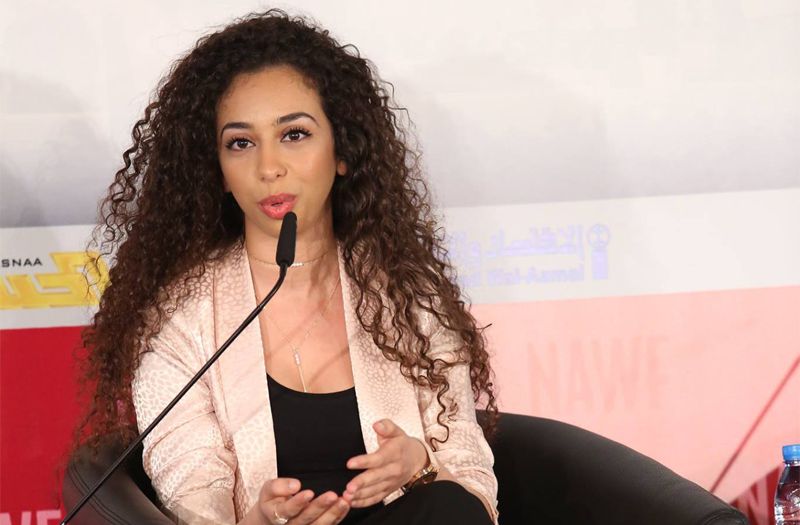
This month’s interview is not 7 minutes, but 15 minutes. When you meet my guest and the cause she fights for, you will understand why. Sana Afouaiz is a women’s advocate, activist and speaker specialized in global feminism and the gender issue in the MENA region. The first time I saw her in one of her talks, her deep Mediterranean voice full of determination echoed in my soul. I have followed her ever since then.
She uses her platform to advance the equality agenda through story-telling, social campaigns, as well as sharing tools to empower women. Sana is also a blogger, many of her posts have been shared on World Pulse, Foresight For Development, MENAC, WECAN, Organization for World Peace, Restless Development and so on.
Sana has visited the United Nations and European Union to speak about and advocate for women’s empowerment. These experiences led her to organise successful campaigns to reform a Moroccan law that allowed rapists to marry their victims in order to avoid jail.
In recognition of her achievements, Sana was named as one of 10 most inspiring women who have inspired change in the MENA region by the World Bank in 2018. Sana was nominated among SE100 most inspiring Social Innovations and Social Entrepreneurs around the world by Social Enablers, she was awarded Ashoka Changemaker Award, and she has been nominated for 2016 CIVICUS Nelson Mandela – Graça Machel Innovation Awards and the MENA Female leader for G(irls)20.
For the past five years, Sana has advised the United Nations, the European Commission as well as other institutions on the gender agenda. She was heavily involved in SDGs discussions, she helped to draft resolutions and recommendations designed to promote women’s empowerment. In 2015, she established the Womenpreneur Initiative, a network that supports more than 500 female entrepreneurs and entrepreneurship every year to grow their initiatives, leadership and their social impact.
Sana’s community grows day by day. Because the gender gap, as many of the anachronisms against which we still fight today, does not have room in the society that we are building.
1. When and how did you find out about your mission?
Since I was a child, I’ve always felt the need to do something. I grew up with plenty of questions in my head, in a very complex environment where being a woman was a taboo. When I asked my people why did they treat women differently, nobody gave me an answer … As the curious child I was, I kept on asking, until one day I realized that they did not have any answers. I was a feminist without knowing what feminism was yet. I felt I needed to do something to change that situation. We were a family with nine daughters, without any sons. Society treated us in a very frustrating way. When I graduated, being the best in my class, nobody saw that as the achievement it was. For them my achievement would have been getting married. This really impacted on me and it gave me the courage to take the first step.
2. When did you realize that your message had a global dimension?
When I started to travel. I’ve been in more than 35 countries where I had discovered and explored new social, economic and cultural dimensions of women. I’ve seen that women’s reality in Morocco is not that different in other countries, only degrees differ. For example, when I first visited Qatar I thought: “Oh my God, at least we have a certain freedom!”, but in both countries we do have a big issue with the gender gap and the lack of women’s empowerment. And the same happens in the USA, Europe, India, Sri Lanka or South-Saharan Africa. It’s something global. Reading Simone de Beauvoir, Nawal El Saadawi or Fatema Mernissi helped me to confirm to what extent it was a universal issue.
3. How can an average woman reach your platform?
In our organisation we work with more than 500 women every year. We lead initiatives in several countries: Azerbaijan, Spain, Scotland, Morocco and the whole MENA region. We count on our local partners who help us to reach all kinds of women.
4. To what extent can education help to bridge the gender gap?
I used to think that education was enough to solve that issue. But I changed my mind one day when I was supposed to interview a lady from Qatar, with a Harvard PhD, quite a model in her community. When I asked her which social and cultural challenges women were facing, she told me she needed to check with her husband whether she could answer or not and her husband denied it. “Is there anything else you wanted to ask me?” she said. “No, thank you”, I answered. It was a shock to me. Having an education is not enough, for we are moulded by our internal and external conscience. In our community, many women who never attended school have a huge sensibility for the gender issue, meanwhile many graduated women do not understand it. There’s still inner misogyny, inner patriarchy, inner doubts. When people live in a society where everybody does the same, they do not even think about questioning traditions, as they are part of a group and culture that must remain as it is.
5. In many cultures there are still many practices that exist for the sake of tradition. How can women and men reset their mindset?
Across the globe we can find plenty of traditions reflecting the roots of the gender issue. But, on the other hand, as society evolves, new traditions which perpetuate that issue appear.
In countries where genital mutilation is illegal but still practiced, I’ve discussed with local women and men, educated abroad, who supported it because it’s a tradition. As a cultural practice, it’s something invented by people just thinking that this will justify women’s purity. But if we want people to change mentalities, we need to make them think about the origin of genital mutilation: what makes them think that this will erase the human sexual impulse in a woman? Only in this way they could realize it. However, mentalities differ across cultures, so there’s not one way to solve it. Religion has built a mindset that survives across the centuries, so there is huge psychological and behavioural work to do in order to overcome it. In the US we see how the gender gap issue is getting worse. Many women who live in the supposedly more open society in the world didn’t talk for twenty years about their stories of sexual abuse.
I am convinced the solution will come from science and technology. Our way of interacting and behaving is changing. So probably technology will make women and men see each other in a different way.
6. How could successful women help those who are fighting? Which role does mentorship play in the process?
I strongly believe in solidarity, but we do not only learn from the women who have succeeded. I personally learn a lot from the ones who never made it and I am deeply thankful to them. I have learnt the importance of solidarity and resilience to survive in such a complex environment.
In our platform we have a mentoring network where we connect not only women, but also men. We do not want anyone to be excluded because we are building a society without differences. It’s essential to create solidarity between men and women to learn from each other.
7. How can we contribute, as a community, to create an environment of equal opportunities for everyone? Not only for women and men, but also across regions and cultures?
We all say we want to create a global community to reach all the goals described in the development agendas together. But, somehow, it doesn’t work. We didn’t change our mindset. We still conceive the world as mistrusting others, which creates a very selfish system. We cannot build a better future if our goal is to have as much profit as possible and be better than my neighbour. It’s impossible to create equal opportunities like this. Development agendas are still created according to the conservative idea that they have to bring economical profit. They do not change mindsets because they do not enable a new culture which makes us all equal. That’s the key to building a new society with a brand new moral perspective and fresh values.
Many thanks for inspiring us, Sana!
